
VR Event Planning and Operations in Florida
Virtual reality earns a place at an event only when immersion helps a specific audience do something that a screen, model, or live demonstration cannot do as well. For a Florida buyer, the decision should begin with the learning, exploration, training, or storytelling task—not the headset. THRILLFORGE may help connect an approved VR component to the physical guest journey while specialist partners own the platform, content, and hardware work assigned to them.
Quick answer: Use VR when spatial presence materially improves the intended task and the audience can use it comfortably. Validate the content, throughput, accessibility, hygiene, staffing, privacy, and fallback experience before committing to a public activation.
- Test the use case against a simpler non-VR alternative.
- Prototype the guest sequence with the actual content and operating team.
- Provide an accessible fallback that still communicates the core idea.
Which Event Tasks Can Justify VR?
Useful candidates include exploring a place that cannot be brought to the venue, rehearsing a spatial procedure, inspecting a three-dimensional product, comparing environments, or experiencing a guided point of view. Define the exact action and what the participant should understand afterward. “Engagement” by itself is too vague to justify content production, equipment, staffing, and floor space.
Compare VR with a physical model, large display, touch screen, projection, mobile experience, or staff-led demonstration. Consider audience size, session length, content maturity, repeat use, accessibility, and the value of spatial immersion. If a simpler medium communicates the same idea with less friction, it may be the stronger event choice.
How Should a VR Guest Journey Operate?
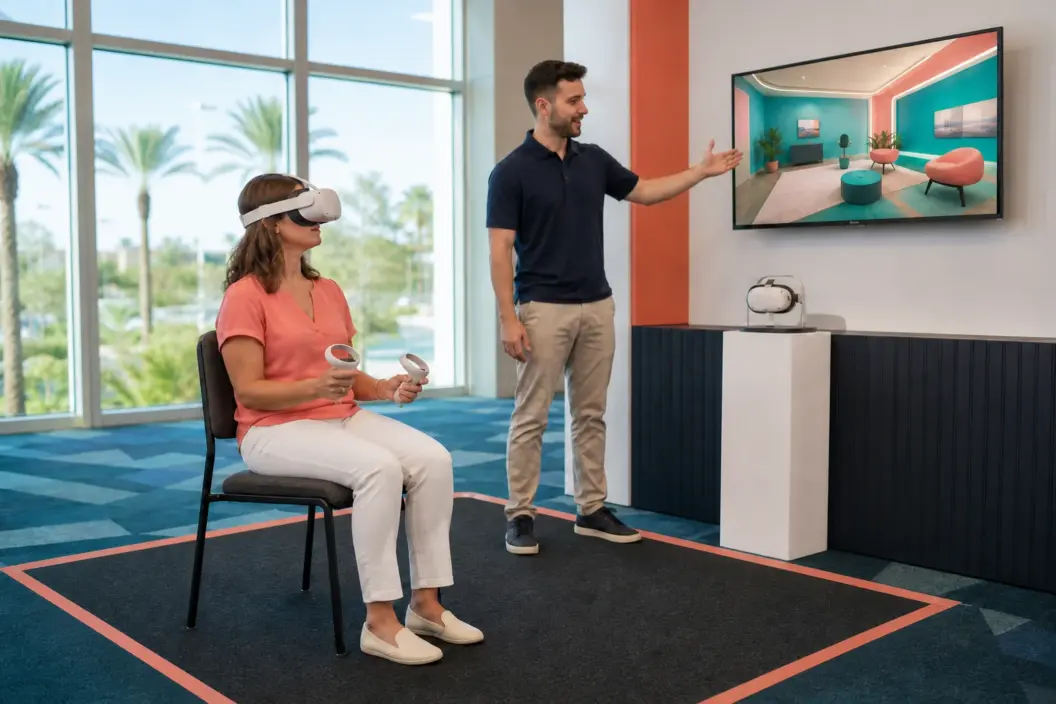
Map invitation, queue, eligibility guidance, orientation, device fitting, controller instruction, the experience itself, removal, cleaning, feedback, and the next brand action. Decide how staff identify discomfort, stop a session, assist a first-time user, protect personal belongings, and reset the station. The surrounding environment should make the process understandable before the guest puts on a headset.
Throughput must be based on the full cycle, not only the content runtime. Include briefing, adjustment, transitions, sanitation, technical recovery, and breaks. Test with representative users in the intended standing or seated configuration. A prototype can expose confusing controls, motion discomfort, cable conflicts, bottlenecks, and staff workload before the event.
What Must the Technical and Content Scope Define?
Specify whether the experience is standalone or connected, seated or room-scale, interactive or guided, single-user or synchronized, locally managed or dependent on internet access. Identify content ownership, supported devices, update process, audio method, language needs, analytics, storage, power, charging, device management, technical support, and a tested recovery procedure.
Hardware and specialist partners should be selected only after those requirements are clear. The responsible content and technology providers should confirm compatibility, licensing, security, support, and deployment method. THRILLFORGE should not be presented as owning a VR platform unless a separate verified offering establishes that fact.
How Do Accessibility, Privacy, and Safety Affect the Decision?
Not every guest can or will use a headset. Provide a meaningful alternate view, such as a mirrored display, guided video, physical demonstration, or another interaction that communicates the central story. Review seated access, reach, vision, hearing, language, balance, mobility, age guidance, and the ability to opt out without losing the wider event experience.
If the system records identity, voice, movement, gaze, responses, or contact details, the organization controlling the data should define notice, consent, purpose, access, retention, and deletion with appropriate legal and security review. Venue and responsible technical parties should also confirm floor boundaries, trip prevention, supervision, cleaning protocol, and emergency procedures.
Where Can THRILLFORGE Support a VR Activation?
THRILLFORGE may help assess how a virtual component connects to the physical event concept, footprint, branded environment, queue, staff positions, production schedule, and guest transition. Platform selection, software development, device configuration, information security, and specialist technical support should remain with the qualified parties assigned in the written scope. Review related Services only after the use case is defined.
Bring the audience, objective, content concept, venue, expected participation pattern, accessibility needs, platform status, technical contacts, budget parameters, schedule, and intended follow-up. THRILLFORGE can then discuss whether environmental design or production coordination is a relevant fit without promising adoption, dwell time, leads, or commercial return.
Frequently Asked Questions
- How do I decide whether an event really needs VR?
State the guest task, compare VR with simpler media, and test whether spatial immersion materially improves understanding or action for the intended audience.
- How many guests can use a VR station?
Capacity depends on briefing, fitting, content length, sanitation, transition, technical recovery, staffing, and the number of stations. Measure the complete tested cycle for the selected system.
- What should guests who cannot use a headset experience?
Offer an accessible alternative that communicates the same core idea through an appropriate display, guided explanation, physical interaction, or other medium.
- Does THRILLFORGE provide the VR platform?
This page does not claim an owned platform. Any content, software, hardware, data, or specialist support must be identified and assigned in the project scope.