
Event Signage in Florida for Outdoor Experiences
Outdoor signage has two jobs before it has a style: help people make the right decision and remain appropriate for the site where it will stand. Buyers comparing event signage in Florida should begin with decision points, viewing distance, message hierarchy, placement, and the venue’s requirements. THRILLFORGE can develop the branded physical system around that information rather than treating signs as a late print order.
Quick answer: Build the sign plan from the guest route. Assign one primary instruction to each decision point, size it for the real approach distance, and confirm surfaces, mounting, access, lighting, and weather exposure with the venue before fabrication.
- Mark entrances, route choices, queues, destinations, and exits on the site plan.
- Keep directions readable before adding sponsor or decorative information.
- Resolve placement and support methods for the specific venue and surface.
What Problem Should Each Sign Solve?
Walk the route as a first-time guest. At every point where someone could hesitate, turn, join the wrong line, or miss a destination, write the decision that must be made. That creates a useful sign schedule: arrival identification, directional wayfinding, queue instructions, sponsor recognition, program information, accessibility routing, service areas, and exit guidance.
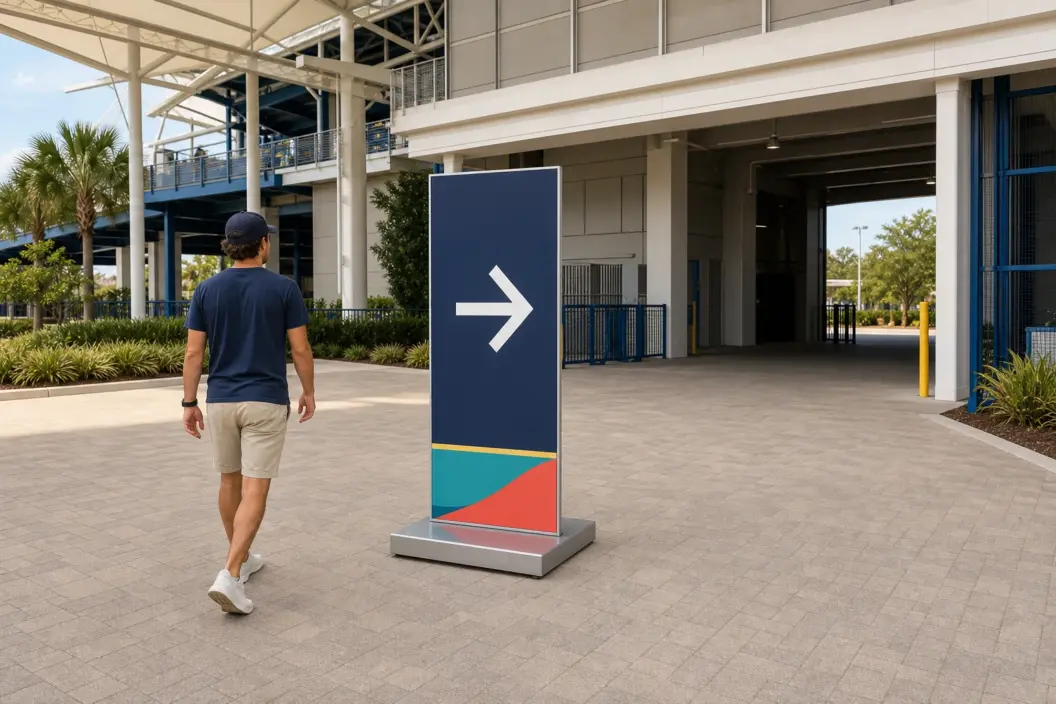
Not every message belongs on one panel. A directional sign should lead with the destination and arrow. Sponsor recognition can occupy a planned secondary zone. Detailed schedules or terms belong where people can stop without obstructing circulation. Separating those jobs makes the system easier to read and easier to update.
How Do You Set Hierarchy, Scale, and Placement?
Start with approach speed and distance. A driver entering a field, a pedestrian crossing a resort lawn, and a guest standing in a sponsor queue need different type sizes, contrast, and information density. Site photos taken from the guest’s viewpoint are more useful than evaluating every panel as an isolated artwork file.
Placement should account for landscaping, parked vehicles, temporary fencing, sunlight, nighttime conditions, and crowds that may block lower information. Use a location code on the plan and on the back of each physical unit so crews can match the sign to its intended decision point during load-in.
Wayfinding note: Test the system with someone who did not help create it. If that person needs verbal coaching to reach a destination, the sign plan still has a gap.
What Must Be Confirmed Before Outdoor Fabrication?
Confirm the surface, allowed attachment or ballast approach, usable footprint, underground or overhead restrictions, delivery path, storage, operating hours, lighting, and who controls last-minute message changes. The venue and appropriate technical professionals determine what support method is acceptable for the location and conditions.
Materials should be chosen for the expected duration and exposure. A one-evening hotel terrace, a weeklong waterfront program, and a recurring golf-course installation do not demand the same substrate, finish, frame, or graphic replacement strategy. The goal is a fit-for-purpose system that can be installed and maintained without pretending every outdoor sign is permanent infrastructure.
How Can Branding and Sponsors Fit Without Creating Clutter?
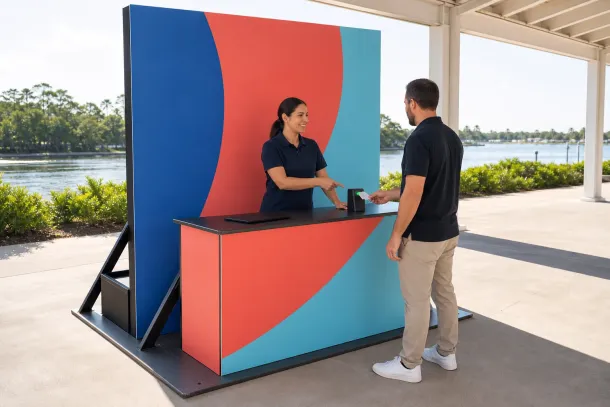
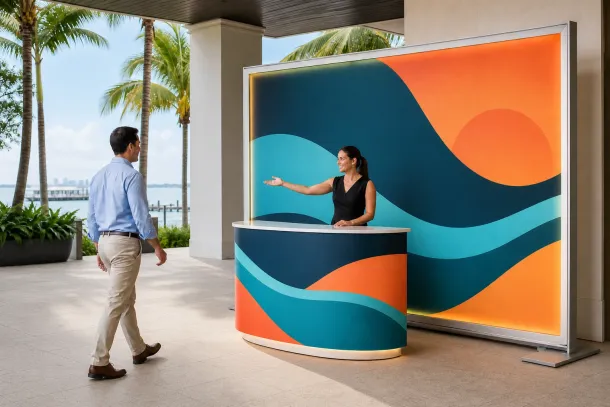
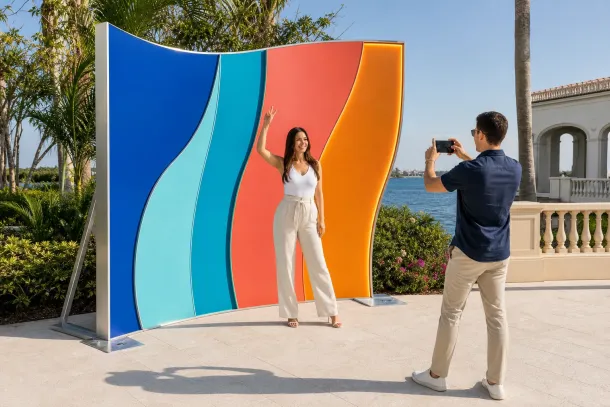
Establish a hierarchy before logos are placed. Primary event identity, guest instruction, venue information, and sponsor recognition each need defined roles. A sponsor can receive strong visibility at natural pause points—arrival, queue, photo, hospitality, or destination—without competing with the arrow or instruction a guest needs immediately.
Build an approval matrix showing which party signs off on copy, logos, locations, and final production files. This is especially important when multiple sponsors or program changes are involved. Replaceable graphic zones can keep the physical frames useful while allowing approved messages to change.
How Can THRILLFORGE Help Build the Sign System?
THRILLFORGE can help translate the route, brand hierarchy, and venue information into coordinated sign families, physical frames, graphic surfaces, and an installation map. The service is most useful when signage, scenic elements, sponsor touchpoints, and guest flow need to feel like one environment rather than separate vendor orders.
Send the current site plan, guest entrances, destinations, schedule, venue rules, brand files, sponsor requirements, operating times, budget range, and photo or video references from the site. Those inputs allow the team to identify missing decisions before artwork and fabrication are advanced.
Outdoor Event Signage FAQs
- How many signs does an outdoor event need?
The count follows the route and number of decisions, not a standard formula. Map entrances, turns, queues, destinations, services, accessibility routes, and exits to build the schedule.
- Who approves the support or mounting method?
Final acceptance belongs to the venue, with qualified review added wherever the site, surface, exposure, or local requirements call for it.
- Can sponsor panels be changed between events?
Yes, when replaceable graphic zones are designed into the frame and the new artwork follows the approved dimensions and material specification.
- Should QR codes appear on directional signs?
Only where guests can safely stop and scan. Do not make a moving guest use a phone to understand a basic direction that should be visible on the sign itself.
THRILLFORGE — FORGING LEGENDARY EXPERIENCES.