
Festival Activations in Florida for Sponsors and Brands
A Florida festival activation must deliver a clear sponsor interaction in a crowded, outdoor, high-throughput environment. It needs an obvious invitation, controlled guest flow, practical staffing and restocking, site-appropriate construction, and a response to heat or changing weather. THRILLFORGE plans the physical footprint around how the activation will operate in the field.
Quick answer: Define the guest action and operating capacity, then design entry, queue, participation, exit, shade or comfort, staff positions, stock, waste, utilities, security, and weather procedures around the festival site and organizer rules.
- Make the interaction understandable without a long staff explanation.
- Separate guest entry, participation, exit, and backstage replenishment.
- Plan heat, rain, wind, ground, power, waste, and shutdown responsibility for the exact site.
What Makes a Festival Activation Different?
Festival guests are moving among stages, food, sponsors, friends, and scheduled programming. The activation competes for attention but should not create confusion or obstruct the broader event. Its purpose and participation step must be visible from the approach and achievable within the time guests are willing to give.
Noise, crowds, uneven demand, outdoor exposure, and limited backstage space make field operations central to the design. The program should still function when staff changes, supplies run low, devices need attention, or a line forms faster than expected.
How Should the Footprint Handle Crowd Flow?
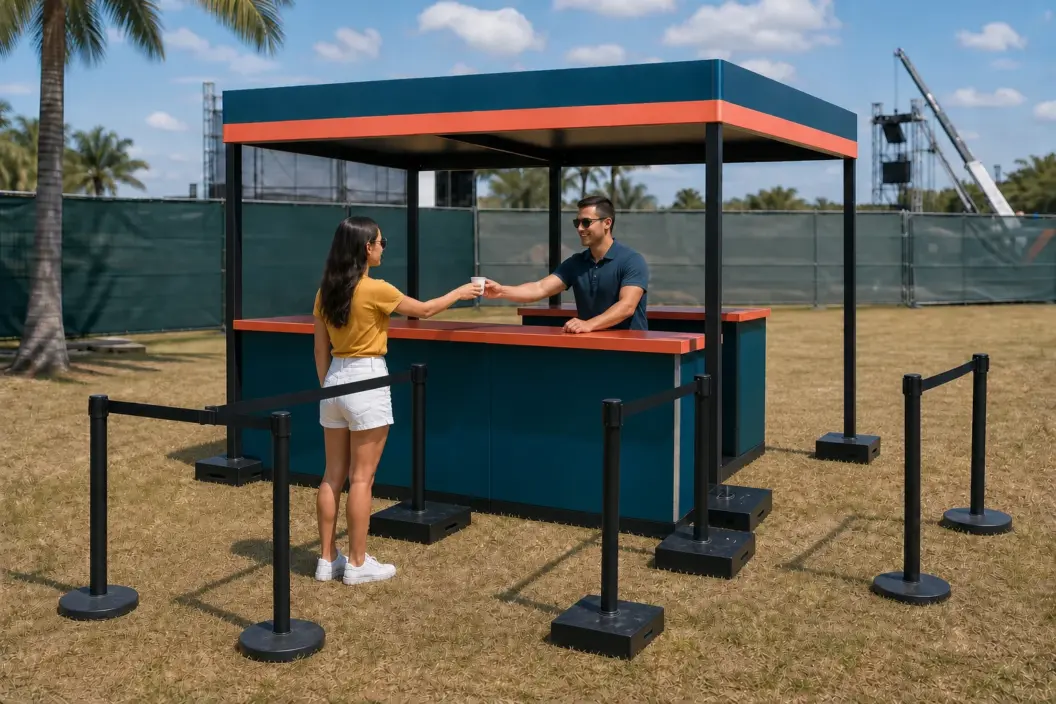
Show guests where to enter, what will happen, and where they will leave. Keep the queue within the assigned footprint and away from emergency access, neighboring sponsors, vendor service paths, and main festival circulation. Observation space should not become an unplanned second queue.
Estimate capacity from the timed interaction, reset, number of stations, and staffing, then test more than one demand scenario. The result is a planning model rather than a promised throughput. Coordinate crowd, accessibility, and safety requirements with the organizer, venue, and responsible qualified teams.
Planning check: Draw the activation twice—once with no queue and once with the expected busy queue. If staff access or the festival path disappears in the second drawing, the footprint is incomplete.
What Should Be Planned for Staff and Restocking?
List product, premiums, collateral, cleaning supplies, waste, personal items, devices, chargers, water, and replacement equipment. Assign storage and a replenishment route that does not cut through the guest interaction. Define opening, cleaning, shift change, count, closeout, and overnight procedures with the operator.
Staff need shade or relief appropriate to the setting, clear roles, concise instructions, and a named decision-maker. If food, beverage, payment, data capture, regulated products, or minors are involved, the client and organizer should establish the applicable permissions, policies, consent, and qualified service responsibilities.
How Do Florida Weather and Site Conditions Change the Build?
Heat, direct sun, glare, heavy rain, wind, wet or soft ground, irrigation, salt exposure, and limited drainage can affect guests, products, electronics, graphics, and finishes. Site-specific requirements and professional guidance determine structural, electrical, and operational responses; generic online rules are not enough.
Create a weather decision path with the organizer and responsible teams: who monitors conditions, who can pause participation, what is secured or removed, where staff and guests go, and who authorizes reopening. The scenic design should never encourage operation beyond that agreed plan.
Which Brands Are a Good Fit for a Custom Festival Build?
Custom fabrication is useful when the activation has a distinctive interaction, product integration, repeatable tour element, service requirement, or sponsor identity that standard tent-and-table components cannot support. A simpler sourced solution may be better for a first test or a program with minimal operational needs.
THRILLFORGE can help connect the guest concept, physical environment, fabrication, and field plan. Bring the festival documents, site plan, footprint, audience, interaction, staffing, stock, utilities, weather responsibilities, brand files, and intended reuse into the brief.
Frequently Asked Questions
- How should a festival activation queue be planned?
Use the timed interaction, station count, staffing, assigned footprint, organizer rules, adjacent traffic, accessible participation, and several demand scenarios to create the plan.
- Does every outdoor activation need shade?
Guest and staff comfort should be assessed for the exact site and hours. Any shade structure also introduces venue, stability, weather, and professional-review considerations.
- Who handles sampling permissions?
The client and event organizer should define required approvals, product handling, service, age restrictions, insurance, and qualified vendors for the specific program.
- What belongs in a festival weather plan?
Include monitoring, decision authority, pause and closure thresholds set by responsible parties, securing or removal actions, staff communication, guest direction, and reopening authority.
THRILLFORGE — FORGING LEGENDARY EXPERIENCES.